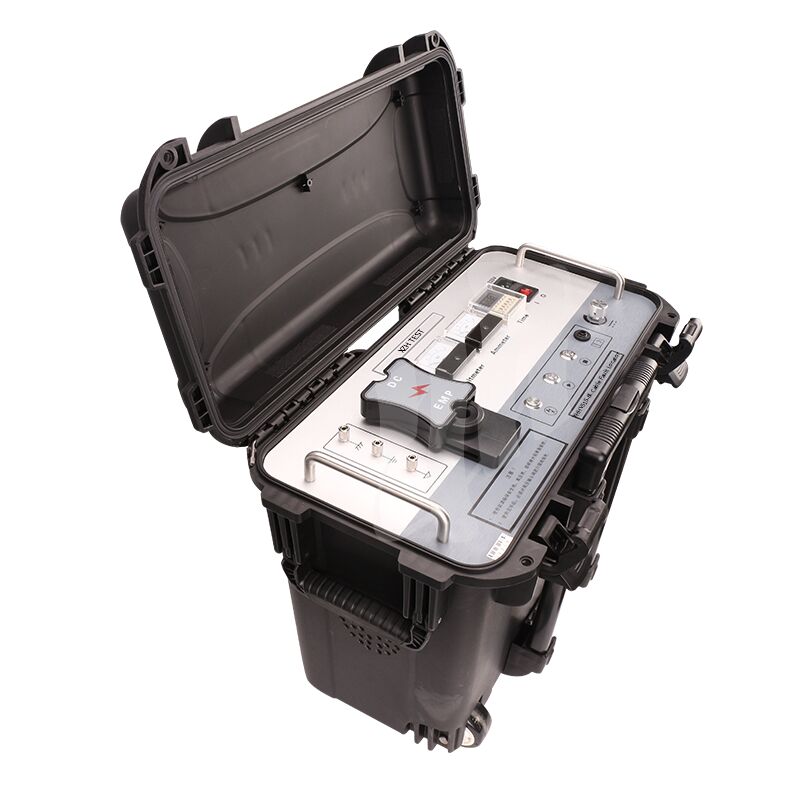
Características do produto:
Medição precisa da tensão em tempo real no lado de alta tensão;
Proteção contra arranque na posição zero para melhorar a segurança e a fiabilidade;
Design exclusivo de medição de alta tensão, que permite ao voltímetro indicar o valor da tensão do condensador em tempo real, mesmo quando parado, proporcionando aos operadores um controlo completo da alta tensão;
O tempo de descarga pode ser definido arbitrariamente em intervalos adequados.

Descrição da função do painel
1. Terra de segurança: Terra o invólucro do instrumento para evitar que o invólucro entre em funcionamento ou que o pessoal receba um choque elétrico.
2Botão de descarga: quando a alta tensão está desligada, pressionando este botão descarrega manualmente a carga interna.
3. Botão de arranque/indicador de posição zero: quando o indicador de posição zero estiver aceso (amarelo), indica que o instrumento está na posição zero.Pressionando o botão de início irá ativar a saída de alta tensão. Quando o indicador de posição zero estiver desligado, indica que o instrumento não se encontra na posição zero.O indicador de posição zero acenderáPressionar o botão de arranque novamente irá activar a saída de alta tensão.
4. Botão de parada/indicador de alta tensão: quando o teste estiver completo ou ocorrer uma anomalia, pressionar este botão irá cortar a saída de alta tensão.O indicador de alta tensão irá iluminar para indicar que a saída de alta tensão foi iniciado; o indicador desliga-se para indicar que a saída de alta tensão parou.
5. Interruptor de proteção contra sobrecorrência: quando pressionado, a função de proteção contra sobrecorrência é ativada; quando solto, o instrumento desencadeou a proteção contra sobrecorrência.Após ligar o dispositivoEm seguida, ajuste no sentido horário para aumentar a alta tensão de saída de baixa para alta.e no sentido anti-horário para diminuir a alta tensão de saída de alta para baixa.
7Interruptor de alimentação: "Posição 1" indica que a alimentação AC 220V está ligada para fornecer energia ao sistema; "Posição 0" indica que a alimentação AC 220V está desligada para fornecer energia ao sistema.
8. Detentor de fusível: local para a instalação de fusíveis no sistema de alimentação AC 220 V.
9. Soquete de alimentação: fonte de alimentação de funcionamento do instrumento, porta de ligação AC 220V.
10. Configuração do tempo: define o intervalo de tempo de descarga.
11. Ampérmetro: Indica a corrente no lado de alta tensão.
12. Voltímetro: Um kV-métro que indica a tensão de saída de alta tensão.
13. Saída de alta tensão (EMP): Conecte a linha de saída de alta tensão durante a descarga de impulso.
14. Saída de alta tensão (DC): Conecte a linha de saída de alta tensão durante o teste de resistência à tensão de corrente contínua.


 Por favor verifique seu email!